 |
 |
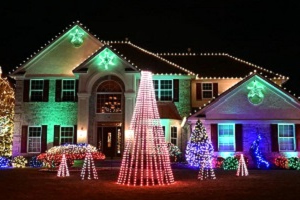
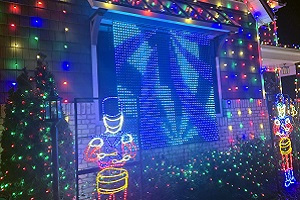
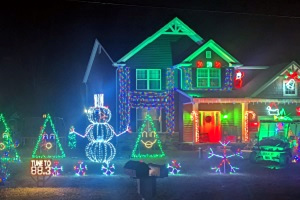
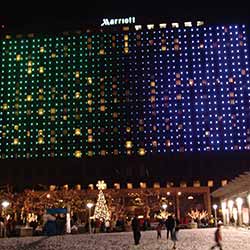
There are four widely used types of lights for residential and small commercial outdoor holiday displays C7, C9, miniature, and rope light. Consideration of multiple factors helps you choose which light type is best for your installation.
|
| |
C7 and C9
These are often classified as the traditional holiday light. They use a screw-in candelabra base similar to common night lights for easy replacement and come in multiple clear and frosted colors. They are connected in "parallel" so that a single bulb failure only affects that bulb.
The primary differences between the two are size and power. C9s are available in 7W or 10W versions and are slightly larger than C7s, which are available in 5W and 7W sizes. They are available with either a 120V rating (with a 2000 hour life) or 130V rating (with a 3000 hour life). With the same color and finish, the higher wattage/larger bulb will be more brilliant and noticeable.
Typically, C7s and C9s come in strands of 25 bulbs spaced 12 inches apart but can also be purchased in 100-bulb strings or 1000-bulb bulk spools. When using 25-bulb strings, do not connect more than three strings in a series. With 100-bulb strings, avoid connecting in a series at all. At 120V, plan on the following current loads with 25-bulb strings for a safe installation:
| 5W bulbs |
1.1 A |
| 7W bulbs |
1.5 A |
| 10W bulbs |
2.1 A |
To specifically calculate load current, multiply the bulb wattage by the number of bulbs and divide by the AC voltage being used. The size of the wire used in the strand determines how many bulbs (or strings) can be connected on one circuit. Most 25- and 100-bulb strands will be fused to prevent excessive current for the wire size used.
Common Uses
C7s and C9s are best for house and building perimeters, large outdoor trees, and where a "traditional" look is desired.
Things to Remember
C7s and C9s get warm and require the most current but are the easiest to replace when a bulb fails. |
| Return to Top |
Miniatures
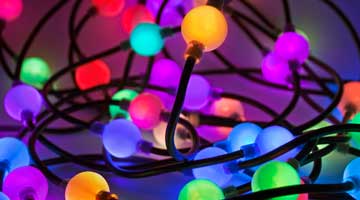
These light strings were conceived to address two of the major concerns power and cost with C7 and C9 bulbs. Miniatures provide many more lights under the same current load as C7s or C9s, and they are much more affordable as a result of the construction and socket type. The most notable difference is that miniatures are wired in "series." Typically, 50 bulbs are connected back-to-back such that a single bulb or socket failure will cause all 50 bulbs to go out.
With miniatures, bulb life will be directly proportional to the quality of the bulbs. While the inexpensive miniatures are commonly rated at approximately 300 hours, higher quality miniatures can last up to 2000 hours.
Typically, miniatures come in 50- or 100-bulb strings with a 100-bulb string only requiring approximately 0.3 A. Bear in mind that most miniature bulbs have a shunt inside to retain conductivity in the circuit if a bulb filament burns out. But if the bulbs that burn out are not quickly replaced, the shunt effectively increases the voltage across the remaining bulbs, reducing their lifetime. And as with C7s and C9s, don’t connect more than three strings back to back.
Common uses
Indoor trees, outdoor bushes, specialty designs and other applications where a large number of points of light are the best effect.
Things to Remember
The less expensive they are, the shorter their life. Consider new strings on an annual basis. |
| Return to Top |
Rope Light
This newer form of light string provides many of the features of miniatures, but in a structure that makes "straight line" installations easier. Rope lights come in single or multiple color varieties. Some multiple color ropes feature each color on a separate circuit, offering the ability to individually control the colors. Essentially, rope light uses a similar technology to miniatures but encloses them in a clear PVC jacket. It usually comes in rolls of 50–150 feet and can be cut to various lengths, typically in multiples of 3 feet to 6 feet.
Rope light manufacturers provide terminations for connecting their rope lights to AC power or splicing together separate lengths. Some times they include mounting brackets to simplify installation, although they are usually specific to their rope light model.
Manufacturers will provide the data necessary to determine the current loads for various lengths of their rope light.
Common Uses
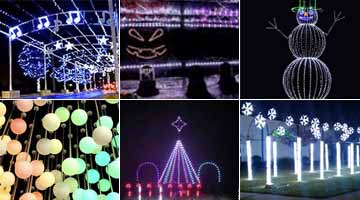
Rope light is ideal for custom designs and figures (e.g. snowman, snowflakes, reindeer, etc.) and when tight, linear installations of bulbs are needed.
Things to Remember
When rope light has a bulb failure, sections as long as 3-6 feet will need to be spliced and replaced. The PVC jacket can also yellow over time. |
| Return to Top |
|
 |